
Western Water Rights and Drought Mandates: Preparing Commercial Indoor Facilities
Quick answer
Newly enacted water conservation mandates and agricultural drought restrictions force commercial indoor and greenhouse facilities to drastically cut wastewater discharge, verify usage via submetering, and operate under volumetric caps or severe municipal surcharges. To maintain compliance and operational viability, facilities must implement closed-loop water recovery targeting 70% to 90% reclamation while transitioning away from open irrigation to precision micro-drip delivery systems.
Key takeaways
- Municipal water utilities across Western basins are enforcing tiered surcharges and mandatory 20% to 50% consumption reductions on commercial agricultural meters.
- Transitioning from flood-and-drain benches or top-pour watering to pressure-compensating micro-drip delivery saves between 35% and 60% of total delivered irrigation volume.
- Permitting boards increasingly require indoor facilities to capture 100% of HVAC condensate and achieve overall facility water recycling rates above 75%.
- Pairing high-porosity substrates like QuickFill coco coir with pulse irrigation minimizes effluent generation and maintains optimal root-zone electrical conductivity (EC).
The Changing Regulatory Landscape in Western Basins
Across the Western United States—specifically within the Colorado River Basin, California's Central Valley via the Sustainable Groundwater Management Act (SGMA), and drought-stressed municipal corridors in Nevada and Arizona—commercial cultivation and greenhouse production face unprecedented regulatory scrutiny. Agricultural operations historically reliant on low-cost municipal water connections or unmetered agricultural groundwater allocations are being brought under stringent industrial classification frameworks.
Water conservation mandates commercial agriculture operators must navigate generally fall into two categories: volumetric consumption caps and discharge limitations. Municipal utilities are deploying automated advanced metering infrastructure (AMI) to monitor hourly demand patterns. Facilities exceeding historical baselines or established per-square-foot allocation limits face escalating tier-four surcharge rates, often multiplying utility bills by 300% to 500%. In extreme drought classifications, municipal codes empower water districts to mandate flat 20% to 50% reductions in total volume, with immediate shutoff penalties for chronic over-allocation.
Concurrently, environmental protection agencies and publicly owned treatment works (POTWs) have tightened effluent standards. Indoor facilities that historically flushed nutrient runoff containing high levels of nitrates, phosphates, and total dissolved solids (TDS) into city sewer grids now encounter strict discharge thresholds. In many jurisdictions, discharging water with electrical conductivity (EC) exceeding 1.5 to 2.0 mS/cm or high concentrations of synthetic salts is prohibited without on-site pre-treatment, compelling facilities to engineer closed-loop solutions.
Target Water Recovery Percentages for Municipal Grid Compliance
To operate legally under modern municipal water conservation ordinances, commercial operations must evaluate their facility-wide water balance. Mandates often demand clear recovery standards before issuing or renewing commercial agricultural occupancy permits.
1. HVAC and Dehumidification Condensate (95% to 100% Recovery Target)
In a sealed indoor facility, approximately 95% to 98% of the water delivered to plants via irrigation is transpired into the ambient air. Dehumidification units and HVAC coils condense this transpiration back into liquid form. Regulatory frameworks in water-scarce districts increasingly classify dumping this condensate into municipal drains as unauthorized water waste. Commercial indoor facilities must recover, capture, and sanitize 100% of this water. Because pure condensate typically reads near 0.0 EC, it serves as high-quality make-up water when sterilized via ultraviolet (UV) irradiation or dissolved ozone to neutralize potential pathogens.
2. Reverse Osmosis Efficiency (75% to 85% Recovery Target)
Standard commercial reverse osmosis (RO) systems historically operated at an inefficient 1:1 or 2:1 reject-to-permeate ratio, meaning 50% to 66% of city water was discarded down the drain as concentrated brine. Contemporary conservation mandates prohibit these high reject rates. Operations must install high-recovery RO units equipped with secondary recovery membranes, anti-scalant dosing, or concentrate recirculation loops to achieve an 80% or greater permeate yield. Brine streams must either be repurposed for non-sensitive utility tasks or processed through evaporation equipment.
3. Runoff Recapture and Bench Drainage (60% to 80% Site Target)
While recovering condensate addresses transpirational losses, facilities must also manage leachate. Runoff generated from salt-leaching irrigation events must be collected via sealed drainage channels. Water conservation guidelines recommend recapturing and recycling 70% to 90% of all liquid that exits the bottom of containers, requiring sterilization and dilution systems before re-injecting clean balanced inputs back into crop lines.
Water Savings: Micro-Drip Delivery vs. Flood-and-Drain Benches
One of the most immediate capital improvements an indoor facility or greenhouse can make to satisfy drought mandates is upgrading the irrigation delivery method. A historical comparison between flood-and-drain benching systems and low-volume, pressure-compensating micro-drip hardware highlights significant efficiency gains.
| Operational Metric | Flood-and-Drain Tables | Precision Micro-Drip Systems |
|---|---|---|
| Delivery Volume per Plant/Day | 1.8 – 3.0 Liters | 0.8 – 1.4 Liters |
| Evaporative Loss from Surface | High (Open standing water layer) | Low (Direct to container/root zone) |
| Standard Runoff Volume | 20% – 40% per cycle | 5% – 15% targeted leaching |
| System Delivery Efficiency | 60% – 70% | 90% – 95% |
| Average Water Savings | Baseline | 35% to 60% Reduction |
Evaporation and Standing Volume
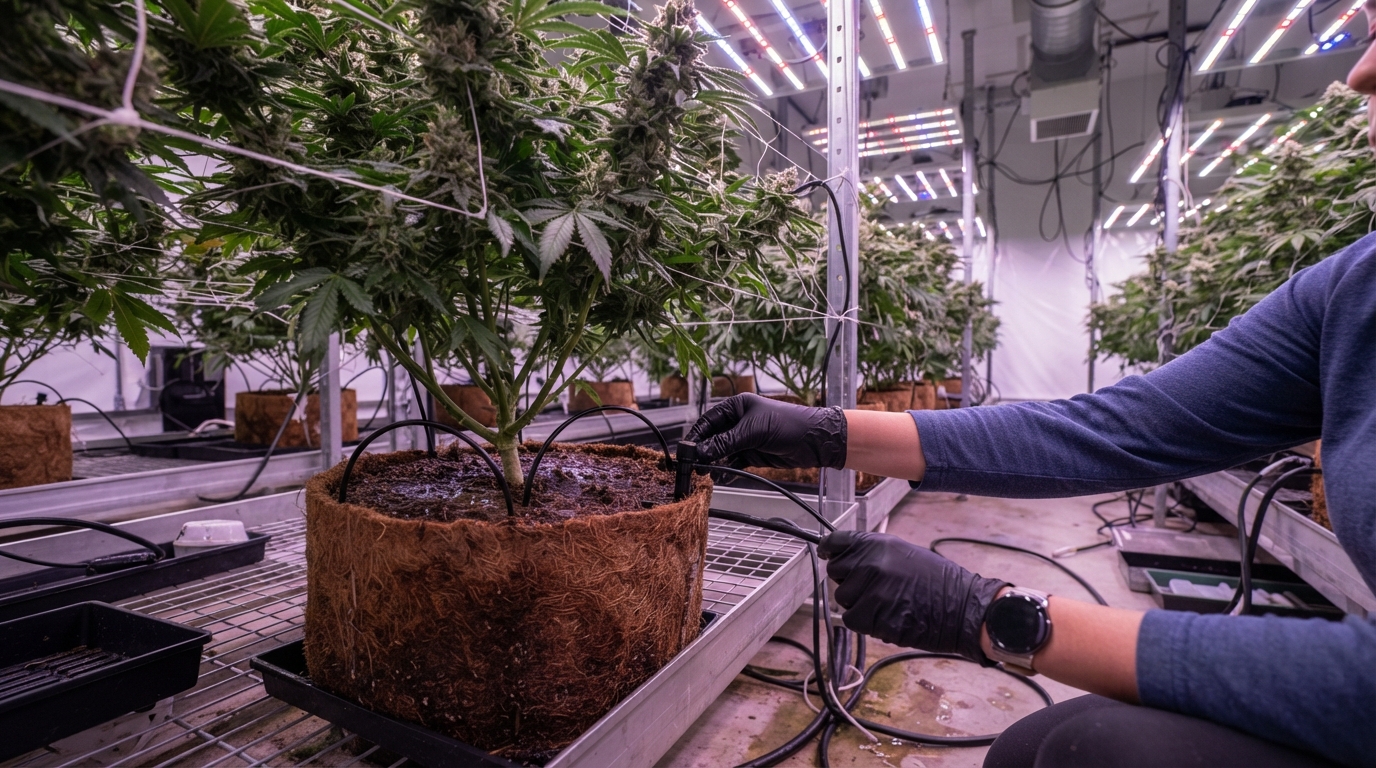
Flood-and-drain systems require filling benches with hundreds of gallons of nutrient solution, exposing large surface areas to atmospheric heat and intense high-efficiency LED lights. This generates substantial unmetered evaporation before the root zone absorbs the required nutrients. Micro-drip hardware—such as calibrated drip emitters, micro-tubing, and top-feed Matrix units—delivers water directly beneath the substrate surface, eliminating open standing water pools and virtually stopping atmospheric bench loss.
Volumetric Delivery and Leaching Control
Flood tables immerse the lower root zone uniformly, often over-saturating the media to ensure that all plants receive moisture. This method prevents precise shot volumes. In contrast, pressure-compensating micro-drip emitters deliver exact volumes (e.g., 0.5 to 2.0 gallons per hour per site) across thousands of feed points simultaneously. Cultivators using substrate moisture sensors can pulse water in micro-doses that match immediate plant transpirational demand, keeping leachate volumes strictly within a controlled 10% leaching window rather than generating excessive runoff.
Substrate and Nutrient Synergy for Water Conservation
Meeting local drought mandates requires engineering the root zone environment to hold sufficient plant-available water while facilitating rapid drainage during targeted pulses. Loose soil mixes with irregular pore structures can channel water downward, resulting in dry pockets and premature runoff.
Standardizing on uniform, high-porosity substrates such as compressed QuickFill coco coir blocks or loose coco-perlite blends optimizes hydraulic conductivity. Coco coir maintains an ideal balance of air-filled porosity (20% to 30%) and water-holding capacity (up to 60% to 70%), allowing irrigation pulses to disperse uniformly across the root profile without bypassing the root zone.
Nutrient selection also impacts water conservation metrics. Low-grade liquid fertilizers often contain high levels of insoluble carrier compounds, sediment, and heavy sulfates, leading to rapid salt accumulation in substrates. To clear these accumulations, growers are forced to run heavy 30% leach cycles, consuming excessive municipal water. Transitioning to clean, highly soluble dry nutrients minimizes ballast salts, stabilizing substrate EC and allowing operations to drop their targeted runoff fraction from 30% down to 8% to 12% without risking nutrient lockouts or root burn.
Implementing Submetering and Compliance Reporting
Water districts facing intense supply strains often require commercial operators to present comprehensive engineering audits demonstrating water-neutral or highly efficient designs before approving capacity expansions. Facility operators must implement detailed submetering networks across their facilities:
- Domestic/Sanitary Inflows: Isolating bathroom, breakroom, and janitorial lines from operational cultivation inputs.
- RO Supply and Reject Meters: Tracking exactly how many gallons enter the filtration system, how many reach nutrient mix tanks, and the volume of concentrated brine generated.
- Irrigation Delivery Submeters: Verifying pulse volumes sent to specific cultivation zones.
- Condensate Recapture Flowmeters: Demonstrating to municipal auditors that transpirational water is successfully reclaimed rather than discharged into city sewers.
By integrating submetering data into central building automation or facility management platforms, commercial operators can verify an ongoing 75%+ water recovery efficiency, insulating their businesses against regulatory shutdowns, tiered rate hikes, and emergency drought curtailments.